

Start with a comparable scope, then enter real prices
Fence prices change by country, region, season, material grade, height, wind design, soil, access, and contractor availability. A universal “cost per foot” can be a rough conversation starter, but it becomes misleading when it hides gates, demolition, concrete, permits, delivery, difficult terrain, or a different specification. The calculator below deliberately begins at zero and asks you to enter a current installed price from a supplier or contractor.
Make every quote describe the same scope. Record total fence length, height, style, material and finish, post size and spacing, footing assumptions, rails or framework, fasteners, number and size of gates, removal, disposal, permit responsibility, delivery, tax, restoration, and warranty. If one quote includes a steel gate frame and another prices a light wood leaf, their totals are not directly comparable.
The planning equation used here is straightforward: line cost equals fence length multiplied by installed price per foot; gate cost equals gate count multiplied by price per gate; removal equals existing-fence length multiplied by removal price per foot. Add fixed permit, delivery, or site costs, then apply a visible contingency percentage. Treat every monetary field as the selected currency. The tool offers USD, CAD, and AUD to match the site’s primary markets while keeping the arithmetic identical.
For a material-only DIY estimate, do not use a labor-inclusive rate. Build the quantity list in the main Fence Material Calculator, attach unit prices to posts, rails, pickets, concrete, and gate hardware, then add delivery, tool rental, permits, tax, and a clearly labeled contingency.
What belongs in a wood fence estimate
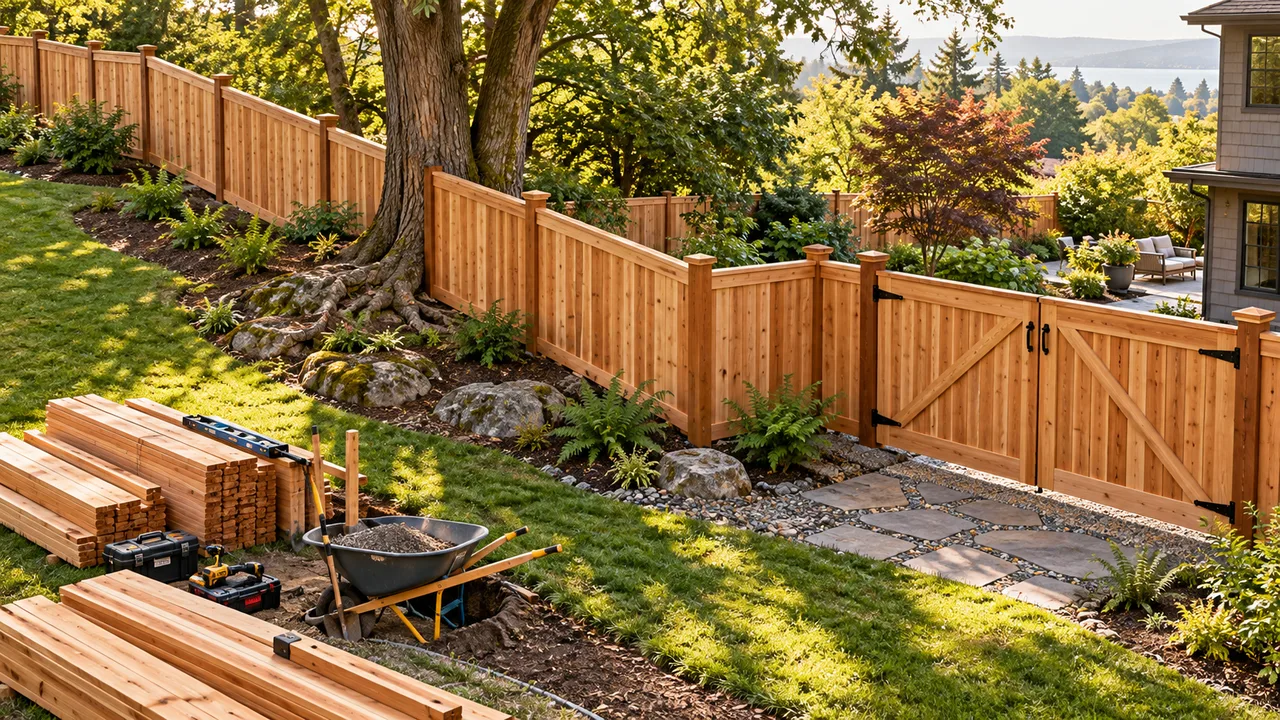
A wood fence takeoff usually includes posts, rails, pickets or boards, concrete or another approved foundation, exterior-rated fasteners, brackets where specified, post caps, gate framing, hinges, latches, drop rods, and finish. Species and grade matter. Cedar, redwood, pressure-treated pine, and locally available durable species differ in price, appearance, strength, treatment, and maintenance. Verify that ground-contact components carry the appropriate treatment or durability classification for their use.
Board dimensions can be nominal rather than actual, and coverage depends on style. A board-on-board privacy fence needs overlap; a shadowbox fence uses boards on both sides; a spaced picket fence needs the selected gap; horizontal designs may require additional posts or framing to control movement. Do not price “100 feet of boards” until the chosen profile and actual coverage are known.
Labor includes layout, digging, concrete, cutting, fastening, grade transitions, gate construction, and cleanup. Wood can adapt well to irregular sites because rails and boards are cut in the field, but that flexibility consumes time. Staining or sealing may be an initial line item and a recurring maintenance cost. If finish is excluded from a quote, note that rather than comparing the unfinished total with a fully completed alternative.
Waste allowance should reflect the design. Straight square cuts on consistent stock may need less than a layout with angles, stepped heights, knots, warped boards, and selective appearance. Keep waste visible as a separate assumption. It is easier to revise a 10 percent board allowance than to discover that a low headline price quietly omitted defects and offcuts.

What belongs in a vinyl fence estimate
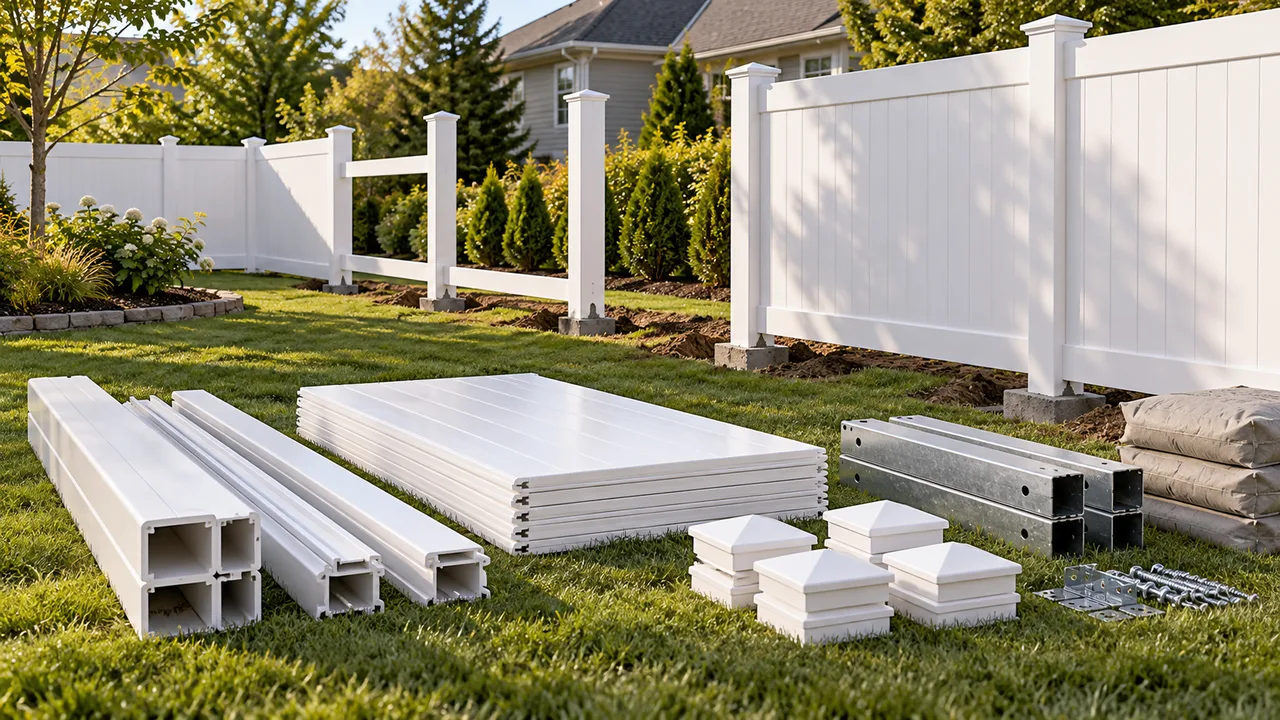
Vinyl systems are usually sold as coordinated posts, rails, panels or infill boards, caps, stiffeners, and gate components. The exact manufacturer and product line matter because profiles and routed openings may not be interchangeable. Price the specified system rather than assembling a budget from unrelated low-cost pieces.
Panel width controls post layout. If the run is not an exact multiple, the installation may need a cut panel or a redistributed layout allowed by the manufacturer. Corners, ends, and gates can require different posts. Metal reinforcement is often used in gate posts or rails, and high-wind installations may have additional requirements. Confirm what is included in a package and what must be purchased separately.
Vinyl is often selected for low routine maintenance, but “low maintenance” does not mean zero cost or zero risk. Surface cleaning, hardware adjustment, accidental impact, replacement panels, and color matching over time belong in the ownership discussion. Dark colors and extreme climates may have product-specific installation limits for expansion and heat.
Labor can be sensitive to layout accuracy. Posts must align with rigid components, and concrete placement cannot casually drift. Rocky ground, buried obstructions, and steep slopes may increase work even when panel assembly is quick. When comparing vinyl quotes, verify panel thickness or product series, reinforcement, footing details, gate construction, wind requirements, and warranty terms. A lower price for a lighter system is not necessarily the same scope.
What belongs in a chain-link fence estimate
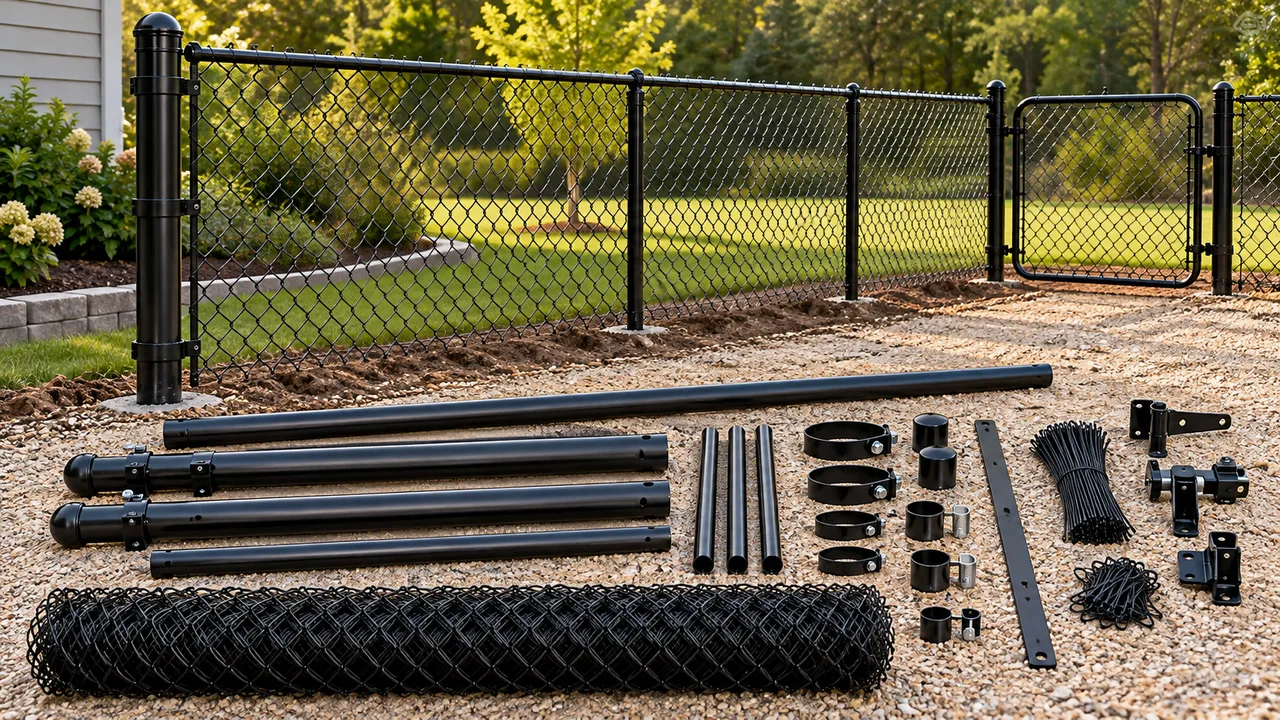
A chain-link estimate includes fabric, line posts, terminal posts, top rail or other specified bracing, tension bars, tension bands, brace bands, rail ends, loop caps, ties, fittings, concrete, and gates. Coating, wire gauge, mesh size, height, framework diameter, and framework wall thickness are important specification differences. Black, green, or other coated systems should not be compared with basic galvanized material solely by total price.
Terminal posts at ends, corners, and gates are typically stronger and use more fittings than line posts. Long runs, changes in direction, grade, security requirements, privacy slats, windscreens, and barbed or tension wire alter both material and labor. Privacy inserts increase wind area and may require a framework designed for the additional load.
Chain-link can provide an economical durable boundary where privacy is not the priority, but gate hardware and terminal assemblies remain meaningful cost items. A wide vehicle gate can require heavier posts, robust hinges, center stops, drop rods, or a cantilever assembly. Price it as an engineered moving component, not merely an opening in the fabric.
Compare quotes by framework and fabric specification, not by the phrase “chain-link fence.” Ask whether concrete, fittings, tensioning, gates, clearing, and disposal are included. For coated systems, confirm that fittings and touch-up methods are compatible. An incomplete parts list can make a material quote appear inexpensive until installation stops for missing terminal hardware.
Labor, terrain, access, gates, and removal can dominate the difference
Two fences with the same length and material can have very different installed costs. A clear, level, machine-accessible line is not equivalent to a steep garden with rock, roots, narrow access, irrigation, and hand-carried materials. Ask the estimator to state the assumed access and how unforeseen subsurface conditions will be handled.
Grade changes add layout and cutting. Corners and short segments add terminal work. Each gate adds structural posts, accurate openings, hardware, adjustment, and testing. Large double or sliding gates may need specialized foundations and fabrication. Pool barriers can require self-closing and self-latching hardware, controlled gaps, and inspection. Never remove a safety or code line simply to match a cheaper quote.
Existing-fence removal includes detaching panels or fabric, extracting posts and concrete, loading, hauling, disposal fees, and repairing disturbed ground. Concrete footings can be heavy and slow to remove. Clarify whether the contractor will remove all below-grade material, cut posts below grade, or leave specified items. Confirm who owns salvaged material.
Other commonly missed lines include survey work, permits, utility coordination, vegetation clearing, stump or rock work, temporary barriers, protection of paving and planting, delivery, equipment rental, tax, paint or stain, restoration, and cleanup. Some are fixed costs rather than per-foot costs. Keeping them separate in the calculator makes it obvious why a small project can have a high effective price per foot.
Normalize contractor quotes before choosing
Create a comparison sheet with one row for every scope item and one column for every bidder. Begin with measured length and drawing revision so everyone prices the same geometry. Record manufacturer or material specification, height, style, post spacing, posts, footings, rails or framework, infill, fasteners and fittings, gates, finish, removal, permits, tax, schedule, warranty, payment terms, and exclusions.
Separate allowances from firm prices. An allowance is useful when a selection is not final, but it transfers price risk. Ask what happens if excavation encounters rock, contaminated soil, undocumented concrete, or utilities. A credible change-order method is more valuable than a suspiciously low number that assumes every uncertainty will disappear.
Check licensing, insurance, references, and permit responsibility according to local practice. Verify warranty scope: material manufacturer warranty, workmanship warranty, exclusions, transferability, and the process for service. A longer-sounding warranty is not automatically broader. Read the conditions and required maintenance.
Do not use this article or calculator to choose a contractor solely by price. Review specification, demonstrated quality, communication, safety, schedule, and total risk. If quotes differ greatly, ask each bidder to explain the scope rather than pressuring the highest to match the lowest. The difference often reveals an omitted gate, lighter material, fewer footings, or a different removal assumption.
Compare ownership and maintenance, not only day-one price
Initial installation is only one part of value. Wood may need periodic cleaning and coating, plus replacement of damaged boards or hardware. Vinyl often needs cleaning and occasional component or gate adjustment. Chain-link may need tensioning, hardware service, coating repair, or vegetation control. Frequency depends on climate, exposure, product quality, installation, and owner expectations.
Build a simple lifecycle worksheet instead of guessing. List expected maintenance activities, a realistic interval range, current unit cost, and the years you intend to own the property. Keep uncertain assumptions visible. Do not claim a precise service life without product, environment, and maintenance context. A material that lasts well in a dry inland yard may behave differently near salt, intense sun, freeze-thaw cycles, or persistent moisture.
Repairability matters too. Site-built wood components may be locally replaceable, while a discontinued proprietary color or profile can be difficult to match. Chain-link components are often modular, but exact coatings and framework specifications still matter. Ask whether replacement parts are available and whether repairs require dismantling adjacent bays.
Appearance, privacy, security, pet containment, neighborhood rules, and environmental preferences also have value that a price calculator cannot score. Use the cost result as one decision column. The best material is the system that meets the project’s functional and design requirements at an acceptable verified total cost.

Final fence budget checklist
Before accepting a budget, confirm that the measured drawing and written scope agree. Recalculate length by straight run, count unique corner and gate posts, and check gate openings. Verify material quantities with the selected product’s actual coverage and installation instructions. Enter current dated prices and identify whether each includes tax, delivery, labor, and disposal.
Keep three numbers rather than one: the base contract or material total, a visible contingency for defined uncertainty, and optional upgrades. Do not hide desired upgrades inside “contingency,” and do not spend the contingency before the work begins. If financing is involved, compare the total paid, fees, and terms rather than only the monthly amount.
- Same length, height, style, specification, and gates across every quote.
- Posts, concrete, rails or framework, infill, fasteners, and hardware included.
- Removal, disposal, clearing, access, restoration, permits, delivery, and tax stated.
- Product and workmanship warranties reviewed.
- Utility location, property boundary, and local approvals resolved.
- Payment schedule and change-order process documented.
- Maintenance and likely repairs considered separately from installation.
Finally, date the estimate. Prices and availability change, so an old worksheet is a historical record, not a live quotation. Build ARG046 does not publish fictional “current averages”; it gives you transparent arithmetic and a place to enter evidence from your market. That makes the result less dramatic, but much more useful.